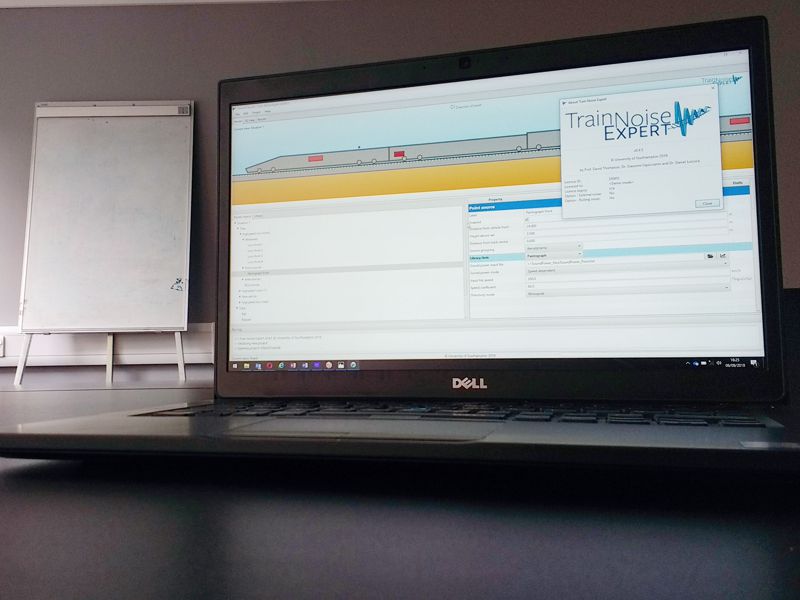

Based on decades of research knowledge and specifically designed for industry professionals, our commercially available software packages give you access to comprehensive tools for predicting noise from trains (Train Noise Expert) and vibration generated by overground and underground trains (MOTIV).
We can also develop bespoke acoustic and vibration programs for defence, rail, automotive and marine applications, or any sector where assessment or prediction of noise and vibration is key.

Advanced software for railway noise prediction and modelling

Our Train Noise Expert software package is a trusted ‘one-stop’ tool for accurately predicting noise from trains and railways, helping you to comply with regulations and minimise environmental impact.
It enables you to specify detailed train and track parameters for various calculations, and to view/export results in multiple formats. Depending on your licence options, it can perform rolling noise and/or external noise calculations.

Rolling noise calculations

The rolling noise calculation option allows rolling noise sound powers and pressures as well as track decay rates to be calculated for wheel and track designs. Calculations are based on the well-known and validated ‘TWINS’ noise model approach. 

  • Wheel and rail roughness spectra can be input separately, or combined
  • Contact filter based on Remington or DPRS models
  • Track decay rates can be based on calculated or measured values
  • Wheel modal parameters derived from finite element model
  • Engineering models of rail and sleeper sound radiation including results from the latest research
  • Track can be specified as having continuous or discrete supports
  • Inclusion of track absorption effects (in beta)

External noise calculations

This external noise calculation is used to predict exterior noise for trains, both at pass-by and at standstill.

  • Standstill and pass-by noise predictions at ISO 3095 standard positions or user-defined positions
  • Noise sources defined as points, areas, lines and boxes with user-defined sound power/ directivity as well as options for speed-dependency terms
  • Rolling noise sources can be manually input as sound power spectra or, with the rolling noise option, automatically imported from previous rolling noise calculations
  • Predictions of noise levels in 13 octave bands and overall A-weighted level
  • Vehicles can be copied and edited within a virtual train
  • Inclusion of Doppler effect for moving sources
  • Inclusion of ground absorption and trackside noise barrier effects
  • Powerful graphical interface including 2D and 3D view of the sources and receivers relative to the train
MOTIV logo

A powerful tool for railway vibration prediction

Ground vibration is another critical issue for railway line planning and maintenance. Our MOTIV software enables you to predict vibration from surface and underground railways and assess the performance of vibration countermeasures to the track and/or the train vehicles. 

With a user-friendly graphical interface, it uses state-of-the-art techniques to perform predictions of vibration levels in the track vicinity and at the ground far field. 

Applications include: 

  • Vibration level assessment at the far-field
  • Predict ground‑borne and structure‑borne vibration for new alignments and upgrades
  • Evaluation of track designs
  • Test mitigation options (eg resilient fastenings, floating slabs, ballast mats) and quantify benefits (insertion loss)
  • Static and dynamic rail deformation
  • Comparison of vibration emission of different rolling stock types
  • ISO 14837 – FTA/FRA source–propagation–receiver framework to predict force density

How it works: 

  • Define the system: vehicle, wheel/rail roughness, trackform, subgrade
  • Run applications: Single aim runs, or sweep runs for  “before/after” mitigation
  • Review and export outputs: One-third octave spectrum graphs, resonance peaks, insertion‑loss curves, deflection curves all exportable to excel or as csv

Who uses MOTIV?

Consultancies, infrastructure owners, track component manufacturers, university labs, and operators across light rail, metro, mainline, and high‑speed.

Proof and assurance

  • Benchmarked against field measurements and published cases
  • Published, peer‑reviewed methodology, well‑documented and accessible
  • Transparent assumptions and traceable calculation steps

Bespoke hardware and software solutions

With broad expertise in signal processing and analysis, we can provide custom solutions for our clients across different sectors, including defence, rail, automotive and marine applications where customers appreciate a reliable and integrated solution.

Solutions could include anything from analysis scripts or interactive spreadsheets, up to full user interface applications, web-based tools, or hardware-integrated embedded systems.

For example, we can design and build custom hardware and software solutions for: 

  • Active noise control
  • Noise and vibration exposure
  • Asset condition monitoring

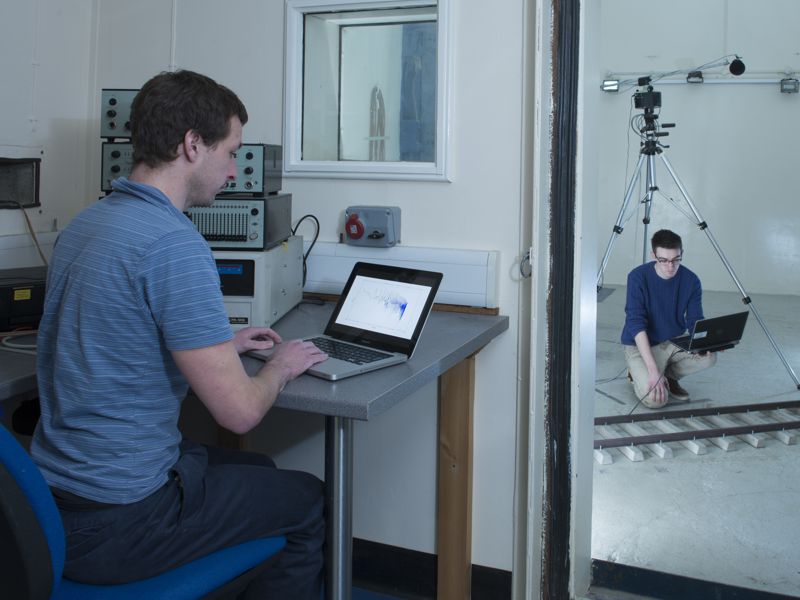
Experts at applying noise and vibration software to our projects

As well as developing tools for our clients, we have our own internal in-house packages we use to provide quality measurements and analysis for our clients’ noise and vibration prediction projects. This enables our expert noise and vibration consultants to gain the robust insights you need, whether you’re at the design stage, testing prototypes or investigating remedial measures.